See Profiles or Blog Stories

Showing posts with label stories. Show all posts

21.1.13

Jean Hegerty - Woman of Courage


By Teresa Notarmaso

Jean Hegerty grew up in the Pennyburn neighborhood of Derry. As a child of the 50’s and 60’s, she lived in an integrated neighborhood of Catholics and Protestants, with four siblings.  The first inkling, she says, of any discrimination of Catholics was when she went on her first job interview.  Because one could not tell by her name (Elizabeth Jean) or the street she lived (Phillips Street), the interviewer asked her where she went to school. When Jean told the interviewer, “St. Patrick’s Primary School”, the interviewer ended the interview, saying that he did not hire Catholics.  Jean was not outraged or horrified by this. She went on to get another job.


In 1965, she left Northern Ireland for Canada with her husband, where she worked for the next few years. Then on one night in 1972, Jean received word that her brother, Kevin McElhinney, had been shot and killed in the Bloody Sunday civil rights demonstration in Derry. She returned for the funeral, and while on the plane ride back, her thoughts initially were of finding and killing the soldier who killed her brother.  


Upon return to Canada, Jean remained there but was still wondering more about why her brother was killed, and who had done such a thing. Meanwhile, the first inquiry (Widgery Inquiry) took place, and the results in 1972 maligned the victims of the Bloody Sunday incident, saying that those shot were guilty of terrorism (and worse).  


Recently, I asked Jean moving forward, whether the peace negotiated in the Good Friday Agreement in 1998 would stand, and what would it take to have complete reconciliation.  Jean’s response: “Integrated schools, beginning with the education of our youngest children.  Jobs and a good standard of living for all.  And the ability to have a good education, which enlightens and provides the road to compassion.”  True words.


How Important is Forgiveness and Compassion?

By Shelley Svedahl

In 1972, ten-year old Richard Moore, was on his way home from Rosemont Primary School in Derry/Londonderry when he was shot in the eye with a plastic bullet. He has been blind since that time.
In an instant Richard's world turned to darkness.

Richard’s story is about forgiveness and compassion
      
                      Richard in his office on St. Joseph's Avenue in Derry/Londonderry.

“I am a victim of the troubles and there is nothing I can do about that but I refuse to be a victim of anger and I do have control over that.”  

                                Richard sees with his heart and focuses on his abilities.

He questions why anyone would want to be angry and live anger.

He believes that forgiveness is a gift for yourself: it’s not for the other person. Forgiveness doesn’t change the past, but it can change the future. Forgiveness is not about the perpetrator; instead it is first and foremost about your ability to let go. When you can do that anything is possible.

Six years ago Richard met the soldier (Charles) who shot him. He rehearsed what he would say at that meeting because he wanted Charles to know he has no animosity towards him and that he forgives him.
                                Dialogue is a bridge and an opportunity to come together.
                                The statue 'Hands Across the Divide' in Derry/Londonderry.

For Richard, forgiveness was easy, but he knows it isn’t easy for everyone. Clearly victims never want to be victims but it doesn’t mean they don’t have the capacity to forgive.
Richard is not saying that by forgiving others you say that what they did was okay. Forgiveness isn’t about justice.

Richard hopes his story is an example of how forgiveness can have an impact on the future. He explained that emotions and feelings are like cells within the mind and each of us holds the key. 

“If my ability to forgive is held by the soldier then he has the key. Sorry is a type of key. If I am unwilling to forgive Charles unless he says sorry, then I have given Charles the key. In my mind, I shouldn’t give Charles the key.”

According to Richard, the peace process isn’t only about what’s happening in Northern Ireland – it’s also about what’s happening internally. He believes we can implement structures of the peace process such as government policies, environmental conditions, dialogue, but those structures mean nothing if you’re not at peace with yourself.

It’s simple. The bottom line is there’s never going to be peace where there is conflict. People need to talk. People need to listen. People need to share. And in the end it’s okay to agree to disagree.

It’s a personal journey and dialogue is the key. Richard wanted to tell his story about forgiveness and compassion to show that forgiveness is possible. He will continue to share his story. In 2009 he wrote Can I Give Him My Eyes?


I only learned of his friendship with the Dalai Lama when I read the back cover of his book. In conversation with other members of the community I heard many stories about Richard's special relationship with the Dalai Lama. The stories were clear evidence of Richard's humanity and further proof that he is a living example of truth, forgiveness and compassion.  
In 1996 Richard Moore founded the charity Children in Crossfire because he wanted to give something back. 

Documentary on Children in Crossfire.

The office of Children in Crossfire at 2 St. Joseph's Avenue Derry/Londonderry

How to Grow a Garden

Gerry Lynn at the Tower Museum
by Amber Luckie

Gerry Lynn's title is "Guide." However, Lynn is so much more than a guide, he is a teacher, historian, philosopher and inspiration. I found Gerry in a chance meeting at the Tower Museum. I shared why our group was in Derry and how we are studying the peace process. He chuckled a bit and asked did you say peace process or peace building? I responded, I suppose both why do you ask? From there, Gerry was gracious enough to share his story. 

Gerry explained building peace as creating a field in farming or planting a garden. In his metaphor stopping the violence is the first step in preparing the field. Currently we are in the process of tilling the field which is in essence starting the conversation. The challenge that crops up currently is like rocks. Imagine plowing a field back in the old days and your plow hits a rock. Those rocks slow the process and the have to be removed. If you don't remove the rocks your field isn't going to be as nice as it could be. He sees the rocks as truth. 

The truth, if not dealt with, like a rock, tends to resurface causing problems if not properly addressed. He thought the most effective way would be a Truth Commission similar to what South Africa had done. Gerry grew up on the Bogside and remembers the Battle of the Bogside as a 10 year old. I had made the assumption that Gerry was Catholic but when I asked Gerry responded with, "If I was born in a stable would it make me a horse?"He is definitely gifted with the use of vivid imagery. I was interested to know how he viewed David Cameron's Apology for Bloody Sunday, he saw it as a positive step in the right direction. The apology enabled a lot of healing for a lot of people in Derry. Gerry also lost his father during the Troubles. His father was caught in cross fire between the IRA and British soldiers. Gerry still doesn't know which side fired the shot that claimed his Dad. He said he has reached forgiveness but still wonders exactly what happened. I asked why the details are important if he feels as he has forgiven the people involved. He responded with, "The Truth sets you free." 

What happens after we remove the rocks, I asked. He said, "Plant the seeds." The seeds are the children and this garden will grow better when the seeds are together. The separation of schools perpetuates issues. He viewed the increased immigration as helping the peace in Derry. The people that relocate here from other countries tend to send their children to the integrated schools. The integrated schools continue to grow and each generation it will improve. With education and exposure to each other prejudices will decrease. Gerry also covered a number of myths in the history most of us have learned, reasoning some history has had better P.R. than others. He told me we're not any smarter than we were we just have the gift of hindsight.

Reaching For Peace


by  Charlie Murray

   Brigid McElroy is a manager of a Hospice Shop for the terminally ill and she has also been a part of Towards Understanding and Healing for many years. She is from Strabane which is where her story began over 40 years ago. Brigid was part of a large Catholic family that included nine children. Brigids father Seamus was an active IRA member that left his family behind and crossed the boader to avoid arrest.  However, he still still spent 1-2 years in prison three different times. He was away from his family for 40 years. During this time Brigid's mother Nora supported herself and the nine children as well as her husband. She did this in a town that had the highest unemployment rate in the industrial world and was once the most bombed town in Europe per size and was the most bombed town in Northern Ireland during the height of the "Troubles".
 

Brigid's family was considered IRA, which in her words means they were "treated as nobody". She was not actively involved, but she had two sisters that were. She has always kept herself and her family away from getting "actively involved" and she doesn't agree with hurting and killing. She wants to have a united Ireland, but "not at the cost of lives".


Brigid didn't know she had a story until she attended a residential. It was there that she realized what she had been through and that someone wanted to listen. She discovered that through the storytelling workshops people can share their stories and begin to heal. They build relationships as well. Some of her best friends are protestants and ex policemen. This is proof that peace can be built through dialogue.


Today, Seamus is back in Strabane and has been in a nursing home for seven years due to Alzheimers. Nora is in poor health, but her mind is strong. Brigid has managed to keep her own family from getting actively involved and is helping others through The Junction and Towards Understanding and Healing. Her hope is for a united Ireland, but she believes that Irelands future will be "tricky" because "everyone will never be satisfied, someone will always be starting up".

Growing peace throughout the island

by Joan Fiesta
Civil Rights mural in the bog side.  Eamonn Deane's image is in the mural.Gerard Deane grew up near the Catholic neighborhoods of the Bogside and Creggan in Derry, Northern Ireland.  Growing up as the son of one of only two paid community workers in Derry, Gerard had a different experience towards understanding peace and reconciliation than most in the area.  Eamonn Deane, Gerard’s father, is a teacher and activist who fought for equal rights for all people in Northern Ireland.  Eamonn was witness to the 1972 Bloody Sunday Massacre, which occurred before Gerard was born in 1973. 
Gerard received his degree in Peace and Conflict Studies from the University of Ulster, Magee Campus.  He was struck by the learning experience there in contrast to what he grew up with and knew.  The program materials covered the conflict in Ireland up until 1968 and then stopped at that point in time, despite the wide breadth of peace and conflict that could be researched in the immediate area surrounding the University. 
Ulster University Magee Campus Strand Road EntranceDuring Gerard’s last year at university, a group of 20 community activists traveled to Israel to learn about the peace process.  The majority of the group who attended the program in Israel used the information from that trip to continue to move towards peace and coexistence in Ireland.  Gerard was impressed by that example.  Though he wasn’t able to go to Israel in that first trip, Gerard was able to participate in organizing the subsequent 1994 exchange trip for Israeli Arabs and Israeli Jews to come to Ireland.  After that, he continued to build his resume in working with the Journeys of Coexistence Project and the North-West Community Network

Gerard Deane in the temporary office home.
His work in peace and reconciliation sprung Holywell Consultancy.  The Consultancy has a different business model than most other organizations active in community building.  Many of the community building and activist network programs are non-profit and run off of grant funding.  Holywell Consultancy, however, is a for-profit social firm that contracts with various community agencies and their partners to provide them with program facilitation, policy-making assistance, and program evaluation.  While it is a “for-profit” business model, Gerard is clear that the profits are, in turn, used to run more work towards the peace process.  By consulting directly with community groups, the Holywell Consultancy helps plant the seeds for others to develop their own capacity for community building.
In working with the community groups who request the Consultancy’s service, Gerard cannot imagine success without dialogue being a basis for the process.  For example, if an agency employs the Consultancy to help create some sort of policy that will help in the governance of a project, it is important that he and his staff listen to those who will be affected by the policy.  For him to come in and say that a policy that worked for one group in Armagh will also work for the affected group in Sligo would not be appropriate or ethical to that group.  

Gerard recognized that there are a millions of stories that are part of the history of this island and that the eyes of the world tend to look back on Ireland as an example.  Though many may feel that they are on a small isolated island (an island, off of another island, off of a continent), the diaspora of Irish to other parts of the world puts the eyes of the world back on the island.  So the work that communities throughout Ireland complete is important to many in the world. 
The Diamond War Memorial

Gerard pointed out that community building is not related solely to The Troubles.  Some of the border counties, including Donegal and Sligo, do not necessarily have the same tangible effects from The Troubles that Derry and Belfast have.  There, however, are other hurts from history that communities may be working to reconcile.  County Sligo, which sits 30 miles beyond Northern Ireland’s border with the Republic, suffered a great human loss in World War I.  Sligo never had the chance to reconcile with both the human and economic tolls caused by approximately 1000 men from Sligo town and an additional 500 from the countryside marching off to war.  Over 400 of the men died in the war, but silence existed around the long-lasting effects of the loss.   Sligo, therefore, did not have healing opportunities.  Gerard’s group is consulting with local programs where remembrances around World War I and World War II lead to understanding about the processes of peace and reconciliation. 

Community reconciliation such as those around the Great World Wars are effective for people in the cross-border counties to understand reconciliation and healing.  They also help people in these locations to prepare for issues of future reconciliation needs, such as those involving non-traditional Irish, i.e. immigrants from different European countries and other continents.  Where the Irish are historically used to emigrating, membership in the European Union and a short-lived economic boom made both Northern Ireland and Ireland open to immigration.  Gerard is working to prepare people to positively deal with intercultural conflict as it arises.

Locally, Gerard actively collaborates with members of the DiverCity Community Partnership to transform the area around the Diamond into a place where people from all identities and backgrounds can safely meet.  He shares vision for The Diamond:  it will be an area that celebrates diversity, be a change from sectarianism and prejudice, and be a symbol of professional partnerships that promote working better and stronger together.
Part of this vision includes the new building that the DiverCity Community Partnership will work out of:  10-14 Bishop Street, right off of The Diamond.  This building will provide a shared space for public discussions, story-telling, and a garden.  It will have a youth area in the basement and office spaces at the top.  The offices will have community partnership entities that serve the various needs of the community, so that people can easily access different services.

The ground floor of the building is designed to be the place for storytelling and dialogue.  There is a large public meeting room in the front.  The back part of the ground floor will house a story-telling and collection area where two members of a family can come and record their stories.  Each family member will receive a copy of the recorded story and one will be housed in the building. 

Though initial plans for the building started in 2005, the project has taken some time, as well as a lot of collaboration and effort, just like the peace process.  Currently, a battleship grey-painted plywood wall and structural scaffolding along the facade mark the front of the building site.  Many of the community partners, including Gerard’s Holywell Consultancy, are wedged into a small temporary office off of The Diamond.  But when it is completed, the partners will take their places in a new building, built through collaborative effort.  It will help provide a space for people to discuss and reconcile with the experiences before and after 1968 and not ignore them…and Gerard’s been a part of it.

Wind of Change


By: Jill Tellez

“A Society that is without the voice and vision of women is not less feminine, it is less human”.    
  Mary Robinson, former President of Ireland and UN High Commissioner for Human Rights. 

St. Augustine's

Growing up in Derry in the 60’s, Catherine Cooke only knew a life that included The Troubles.   During that time, there was a mass exodus of Protestants from the City to Waterside and from there her early life would be lived polarized and in isolation from the Catholic citizens of Derry other than going to church at St Augustine's on Sundays.   

  
As a segregated community, they felt stuck and were fixed on the beliefs of what they were fed by the government and the media.   She was also raised to believe you did not challenge the government even if you did not like the way things were. 

The Shirt Factory Horn - courtesy of BBC Northern Ireland
Like many other women in Derry, Catherine’s first job was at a shirt factory, Desmond’s in Drumahoe.  And for many women, this was also the first time they were in an environment with an opportunity to engage with women who were different, from “the other side”.  


www.irishhistorylinks.net
In the late 80’s, now a mother of two young children, a bomb went off three doors down from her home.   Her growing concern for her family’s safety allowed her to be receptive when other women in her neighborhood began knocking on doors in an effort to gain community support to stop the violence.   She first began by contributing to donations for children’s events.  She was then approached and agreed to do typing for the grassroots community organization for peace.  She took a course at the Magee campus in community development and spent 20 years volunteering in this mother’s group. 

 Courtesy of Free Derry Museum
For the past twenty-five years, Catherine has been an integral part of the regeneration and community relations toward peacebuilding  in Derry.   There were times others challenged her by saying, “who elected you to speak for us, or who do you think you are telling us what we should do, or who do you speak for?”  With her strong commitment to build peace, she would tell them she no longer wanted to be part of two cities – there is only one Derry.    As a volunteer, one of the projects she is most proud of is the Interface Forum that she spearheaded – a mobile interface monitoring forum to help reduce tensions and keep people safe on each side of the interface.  

www.wesleyjohnston.com
In her efforts throughout the years, she came to realize that women have been the glue that kept the families and communities together during The Troubles .  She knew that there were other grass roots organizations like hers in each of the 21 diverse neighborhoods of Derry.   In 2004, she became the link between the neighborhoods and formed the Foyle Women’s Information Network (FWIN) – The Walled City Community Partnership.  www.fwin.org.uk


In eight short years, FWIN’s membership is at 350 women.  The board consists of 21 women, one voice from each neighborhood in Derry.   The organization’s mission is to provide a safe forum for women from culturally diverse communities within Derry to access information, education, training and support.  FWIN is instrumental in encouraging crucial dialogue to take place in tackling inequalities collectively and for information to be linked to all of the other grassroots organizations that were previously operating in isolation.    
As part of International Women’s Day, 108 women took part in training workshops to help ensure more women ‘find their voice’ and are ready and supported to take leadership roles in public life.  The workshops included voice coaches and learning the art of public speaking.  

Women's Manifesto - then and now

Working to achieve gender equality, FWIN was again part of a coalition who created a Women’s Manifesto:  Equality Standards for Women and the Economy, Childcare, Decision Making, Education, Reproductive Health and Violence Against Women.  


Catherine’s role in connecting and empowering women to build relationships, not political parties, has been extremely effective and applauded on international stages, most recently in Vienna at a conference on 'Empowering Women'.  
 Catherine Cooke truly is part of the wind of change for peace in Derry.  


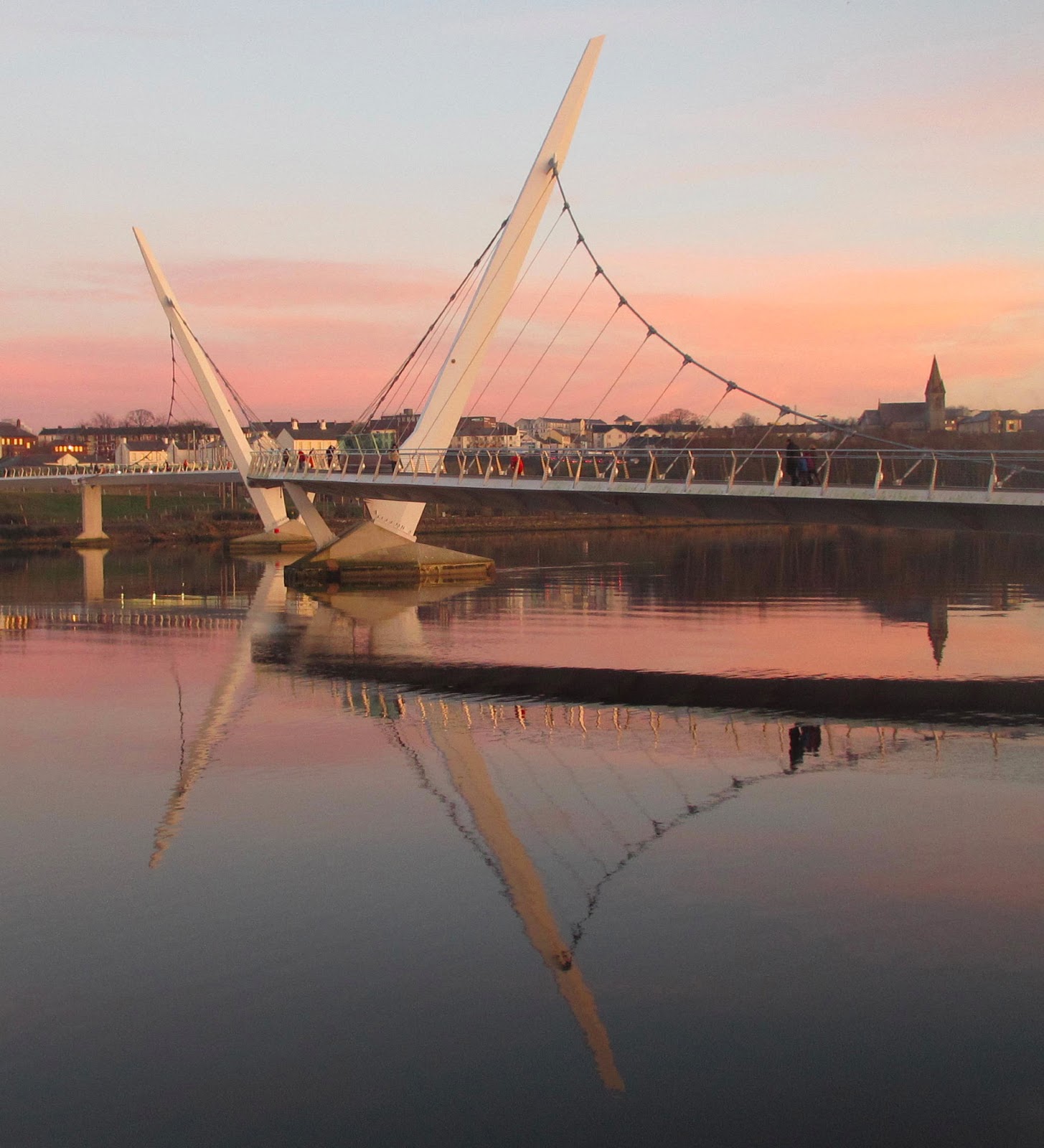
Peace Bridge over the River Foyle - Derry, Northern Ireland


-->