See Profiles or Blog Stories

21.1.13

Wind of Change


By: Jill Tellez

“A Society that is without the voice and vision of women is not less feminine, it is less human”.    
  Mary Robinson, former President of Ireland and UN High Commissioner for Human Rights. 

St. Augustine's

Growing up in Derry in the 60’s, Catherine Cooke only knew a life that included The Troubles.   During that time, there was a mass exodus of Protestants from the City to Waterside and from there her early life would be lived polarized and in isolation from the Catholic citizens of Derry other than going to church at St Augustine's on Sundays.   

  
As a segregated community, they felt stuck and were fixed on the beliefs of what they were fed by the government and the media.   She was also raised to believe you did not challenge the government even if you did not like the way things were. 

The Shirt Factory Horn - courtesy of BBC Northern Ireland
Like many other women in Derry, Catherine’s first job was at a shirt factory, Desmond’s in Drumahoe.  And for many women, this was also the first time they were in an environment with an opportunity to engage with women who were different, from “the other side”.  


www.irishhistorylinks.net
In the late 80’s, now a mother of two young children, a bomb went off three doors down from her home.   Her growing concern for her family’s safety allowed her to be receptive when other women in her neighborhood began knocking on doors in an effort to gain community support to stop the violence.   She first began by contributing to donations for children’s events.  She was then approached and agreed to do typing for the grassroots community organization for peace.  She took a course at the Magee campus in community development and spent 20 years volunteering in this mother’s group. 

 Courtesy of Free Derry Museum
For the past twenty-five years, Catherine has been an integral part of the regeneration and community relations toward peacebuilding  in Derry.   There were times others challenged her by saying, “who elected you to speak for us, or who do you think you are telling us what we should do, or who do you speak for?”  With her strong commitment to build peace, she would tell them she no longer wanted to be part of two cities – there is only one Derry.    As a volunteer, one of the projects she is most proud of is the Interface Forum that she spearheaded – a mobile interface monitoring forum to help reduce tensions and keep people safe on each side of the interface.  

www.wesleyjohnston.com
In her efforts throughout the years, she came to realize that women have been the glue that kept the families and communities together during The Troubles .  She knew that there were other grass roots organizations like hers in each of the 21 diverse neighborhoods of Derry.   In 2004, she became the link between the neighborhoods and formed the Foyle Women’s Information Network (FWIN) – The Walled City Community Partnership.  www.fwin.org.uk


In eight short years, FWIN’s membership is at 350 women.  The board consists of 21 women, one voice from each neighborhood in Derry.   The organization’s mission is to provide a safe forum for women from culturally diverse communities within Derry to access information, education, training and support.  FWIN is instrumental in encouraging crucial dialogue to take place in tackling inequalities collectively and for information to be linked to all of the other grassroots organizations that were previously operating in isolation.    
As part of International Women’s Day, 108 women took part in training workshops to help ensure more women ‘find their voice’ and are ready and supported to take leadership roles in public life.  The workshops included voice coaches and learning the art of public speaking.  

Women's Manifesto - then and now

Working to achieve gender equality, FWIN was again part of a coalition who created a Women’s Manifesto:  Equality Standards for Women and the Economy, Childcare, Decision Making, Education, Reproductive Health and Violence Against Women.  


Catherine’s role in connecting and empowering women to build relationships, not political parties, has been extremely effective and applauded on international stages, most recently in Vienna at a conference on 'Empowering Women'.  
 Catherine Cooke truly is part of the wind of change for peace in Derry.  
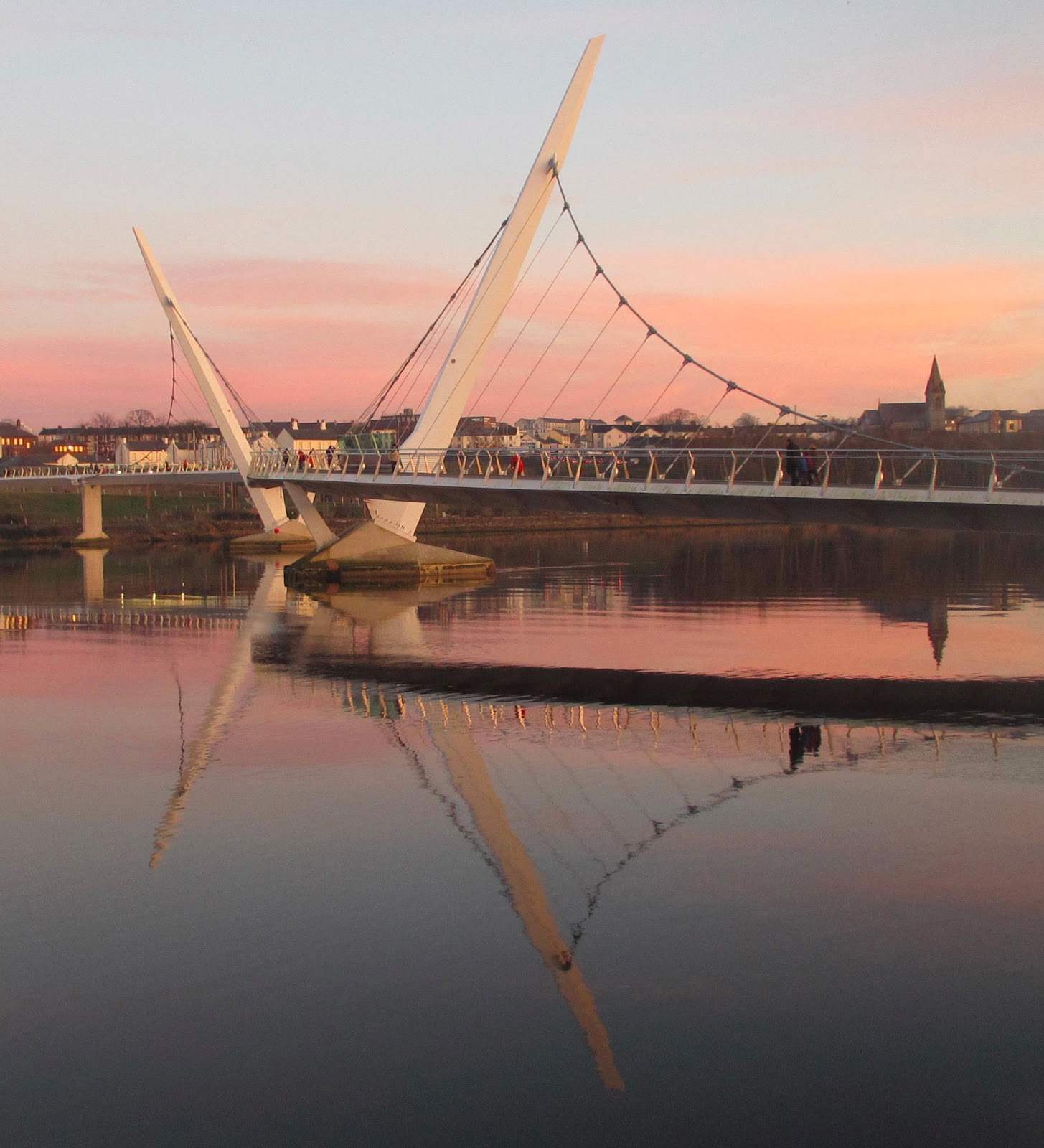

Peace Bridge over the River Foyle - Derry, Northern Ireland


-->

How a city lost its way, but found redemption.

By: Kyle W. Clanney

Over the course of Jim O'Neill's life many things in the city of Derry have changed, but the one place that has not is St. Columba’s Church (Long Tower). This is his place of worship and where he was baptized as a kid. The Long Tower from its inception in 1784 became a symbol of generosity for all faiths and beliefs.
 
Jim's old neighborhood on the Bogside

 Many others kids like Jim were impacted by “The Troubles” and as someone who grew up on the Bogside had distinct memories like hearing the droning of helicopters outside his window at night. Another distinct memory is how he was impacted like the funerals of Bloody Sunday victims. Even though he did not attend the march he stood in solidarity outside of St. Mary’s Church in Creggan. When Jim was grammar school at Lumen Christi College he was arrested and questioned, nothing ever came of it, but it was just another sign of how serious things were in Derry.

 Jim was arrested here as an adolescent and questioned


Jim was able to escape the conflict in Derry at 18, due to being an excellent student. He made his way to Manchester University, where he majored in Social Sciences. One of the first things he noticed once moving away was not hearing the sounds of helicopters outside his windows. During his time in England there were two events while living away that made him realize that the people in the other groups involved were human beings that did many of the same things that the people of his group did. The first happened while living in the residence halls, where he shared living quarters for a year with an army officer named Adam. They were able to debunk the others stereotypes. The second event was while he was working on an adventure playground in a large housing estate called Wythenshawe. This place had its own share of social and economic problems with many students dropping out of school to join the army from there possibly being sent on to Northern Ireland. The movement for Jim into the healing process post Good Friday Agreement started when he went to Lusty Beg and met with Maureen Hetherington along with a number of other trusted friends. This meeting was the crucial step in building the organization Towards Understanding and Healing. The focus of the event and organization was to get all sides (ex-paramilitaries, members of security forces, or victims/survivors who were innocently involved in the conflict in some form. This group is a model of Professor Dan Bar-On’s “To Reflect and Trust”, which was formed to create dialogue between descendants of both the victims of the Holocaust and Nazi perpetrators.

One of the most important meetings for Jim occurred a few years after the start Towards Understanding and Healing, which organized a conference called “Peace is Tough”. One of the people involved with “To Reflect in Trust” who were attending the conference was Adolf “Martin” Bormann, which is the son of Adolf Hitler’s confidante Martin Bormann. Adolf  "Martin" Bormann became a Catholic Priest and worked as a missionary in the Belgian Congo.  During his time with Martin, Jim learned that even though he was not responsible for all the death and carnage his father caused his birth had a purpose of seeking atonement and redemption.

Diamond War Memorial (WWI)


In the last decade Jim discovered that his Great-Grandfather and Great Great Uncle were killed during WWI. His Great-Grandfather was never mentioned in his home and in his mother’s home. He had the honor of taking his mother to visit his plot in Celles, France and while there found that there is a memorial a mile from the cemetery with Great-Grandfather’s name on it as well.


For the last four years Jim has been a Dialogue Development worker for Community Dialogue, which he is a vital piece in the development of it 15 years ago. His group over last year has come up with other methods like using Drama/Theatre and writing/performing music as other methods to help people get their stories out.

A Peaceful Heart

By: Kathleen Fueston
            When you first meet Frances McAneny, you would never guess the ordeal she has been through by speaking to her.  She is warm and friendly. She is a woman of influence by her example and the way she chooses to live her life.  Frances was born and raised in Northern Ireland in the town of Strabane, just 14 miles south of Derry.  Her father was Protestant and her mother was Catholic, but this was never a conflict in her family.  She described her early years by saying “we went about our normal life in an abnormal situation.”  She and her family were not caught up in the Troubles that were going on, but they were aware of them on a daily basis. She remembers driving with her family when gun shots were fired outside the car.  Her father would pull over and they would get out of the car and lay on the ground until the shooting stopped.  Then they would get back in and take off on their previous conversation. 


As a young adult, Frances worked in Belfast for a time.  She worked in a civil servant job which was often a target for combatants. She went through several bomb scares and remembered one time when her office had to be evacuated and they literally had to jump over one of many bombs as they ran out of the building. 


This photo was taken on a wall in Belfast.
When Frances was 32, she was working in her home town of Strabane. She was engaged and just 3 weeks away from getting married to her fiancé Seamus.  One day she was walking into work with a friend who was a volunteer police officer.  Frances met up with him on the sidewalk and about 50 yards before going into their office, sub machine gun shots rang out.  Frances felt a burning feeling in her shoulder and then inside her body. Before she knew it she was in an ambulance on her way to the hospital.  The medics told her she had been shot and that they needed to call her parents.  Frances said that would not be a good idea because her mom would not handle it well, but the call was made.  She was soon in surgery and she does not remember anything else until about 12 days later when she finally awoke.  She was told she had been in surgery over 6 hours and had been given 20 liters of blood.  Surgeons had worked to fix her arm where the bullet had entered her body. They had to repair her lung that had been torn open by the bullet and several ribs that were broken and fragmented.  But even more difficult than that, they had to figure out how to take out the bullet that was lodged between her heart and her main artery. The doctors determined it was too risky to take it out and so to this day she lives with that bullet inside her chest. Just after the surgery the consultant told her family that they had left her comfortable to die.


At one point in hospital, she asked about the details of what had happened the day of the shooting and was told she was the only one shot in that incident and the perpetrator was not caught.  Her analysis is that the bullet was probably meant for her friend, the police officer, but she was hit instead.  In the years since the tragedy there have been speculations as to who pulled the trigger that changed Frances’ life, but no one has been caught or come forward. 


            Frances was in hospital for 7 weeks. There was a patient in hospital by her that required a security guard and that helped Frances feel a bit safer, but the trauma of the incident settled in quickly.  She feared that whoever perpetrated the crime would show up at some point to finish out what they started.  The fear and worry was engulfing at times.  When Frances was released from the hospital her wound had not healed yet. It took from September to December for it to heal, but she had no use of her left arm and panic and dread were constant companions.  They told her they could do nothing more for her and sent her home to get on with her life. They were surprised she had lived this long. 


When one spends time with Frances, you quickly feel from her a quiet peace.
Quote by W. B. Yeats. Photo taken at St. Columb's Cathedral.
Frances’ mother had to take care of her every need for some time. There were days that staying in bed with the blinds closed seemed like the best solution, but in time she knew that was not the solution.  Frances remembered one day when the doorbell rang as her mom was dressing her and she went to get the door.  Frances made up her mind she must start working to get use of her arm back. She flung the lifeless arm over on a rail and pushed herself up to work on getting dressed.   It was hard and painful work to strengthen her arm, but she was determined to be well again, physically and emotionally.  She knew that for some reason God chose to save her life and so she needed to get on with it. In Frances’ words, “We have to go places and go there by the grace of God.”  At that time she was not clear what God’s purpose was for her, but she knew it would be revealed if she moved forward with her life.


          Seamus and Frances had to postpone their marriage for over a year.  What was to be a rather large affair in the town cathedral was changed to a low profile event of 15 in a small parish close by.  Some years passed, but challenges continued.  The doctors told her having children could kill her, but their desire to have a child was greater than the risks or worry. A son was born to them in 1975 and they named him Cairan.


Frances outside the WAVE, the first center she attended
to work on overcoming her traumatic experience.
          Frances looked for resources to help her overcome her fears and to come to peace with what had happened to her.  She went to various programs and had some improvement, but many programs seemed to be biased to one side or the other.  “I kept getting placed in the victim box and I decided I didn’t want to be placed back into that box anymore.  I choose to move from victim to survivor.”  It was in 2000 when she met Maureen Hetherington at The Junction participated in the programs called Towards Understanding and Healing where she was able to tell her story that the true healing began. 


          Frances continues to have physical challenges from her experience and has had multiple surgeries through the years, but she rallies with each one to continue her life and her work.  “I consider everyday a blessing.”


Frances enjoys helping others by facilitating
Bead Sessions where participants select bead
that represent important events and people. those
beads are placed a bracelet which helps people
tell their personal story to others.
          Now Frances has been heavily involved in the work at the Junction. Her favorite project is facilitation work with individuals and groups, helping with storytelling for victims and survivors of the Troubles. She is a part of all that goes on at the Junction, but she likes to be in the background, where she can be quiet and listen. She is often found on the end of the phone and has been known to take calls in the middle of the night to help someone through a dark and anxious time.


          When asked what she would do if someone was charged with the shooting that nearly took her life she said, “I’ve already forgiven them. They have had to live with this knowledge of what they did all of these years.  They have had the harder road, so I forgave them a long time ago.  It does me no good to hold on to such negative feelings. Many people who have been victimized by the Troubles want to be known as such.  I would rather be known as a survivor.”


Frances is a passionate advocate of peace building and she leads others by her own example. She is a mentor to many and she is a quiet woman of influence. When one speaks of her work at The Junction, Frances says “I must keep doing what I’m doing, hoping that what I’m doing will make a difference. It is baby steps and they get us where we need to go. Be gentle with everybody because it sometimes rubs off on people.  Maybe I’m simplistic but I believe we can live in peace.”

Planting Seeds Through Sport

by Leslie Simmons

Peter Hutton at Brandywell, the home of Derry City FC.
Everybody in Derry knows Peter Hutton. Whether he’s walking down the street in the city center, driving his car or visiting his hometown’s football pitch, someone’s got a wave, a smile or a shout out for the former footballer.

His story is the quintessential “local boy makes good.” Growing up in the Creggan, Hutton, 39, picked up soccer early and by 15 was sought-after by local clubs. Eventually, he signed with the local team, Derry City FC, and became a star player for the “Candystripes.” Hutton, who currently manages the Donegal team Finn Harps, has remained loyal to his hometown and committed to contributing to his community.

Working with The Junction, Hutton runs the youth football program Teenage Kickz, aimed at bringing Derry-Londonderry teens together through the sport.

Once a month, he loads up a mobile football field and sets it up in a “neutral” area. Youths from various areas are invited to participate and play together.

“We’re working with blighted communities where anti-social behavior occurs,” Hutton said. “It’s a way to get the kids away from the drinking and other [bad] activities.”

The Creggan, where Hutton grew up, and the Bogside, where he was born, are areas that produced footballers through similar community youth programs, though the Derry native admits he didn’t witness or experience a lot of the violence others in his neighborhood did.

Hutton is featured in artwork along a wall in the Creggan.
Hutton was born in 1973, a year after Bloody Sunday, and the Troubles was a topic his parents, Peter Sr. and Linda, rarely discussed with their six children. Football was what encompassed his life from an early age, and his natural talents exposed him to many sides and cultures and allowed him to travel away from the city.

 “My parents told you what you needed to know [about The Troubles],” Hutton recalled. “They did a good job at shielding us growing up. We were protected. In some respect, we were naïve.

“You came home and you did your homework,” he said. “When you were done you watched a kids program and then that was it when the news came on. And we didn’t read the papers.”

That doesn’t mean he didn’t experience any of the violence. Hutton recalls playing out in the streets one night with friends and witnessing three men get “kneecapped” by the IRA – meaning, they were shot in the knees. Punishment, he said, for “anti-social behavior.”

Hutton also recalled having a run-in with the British army. He was walking into town early on a Saturday morning to pick something up for his mother when a Jeep-like armored vehicle often used by the British soldiers came driving down the road. The vehicle swerved to try to - or appear to - hit Hutton. The soldiers drove off laughing. It’s an incident that stands out to him.

“It was scary in a sense that you had a feeling of being very vulnerable,” he said. “And I couldn’t say anything. Who would believe me over them?”

Football – like the teens he interacts with today – was his outlet. It allowed the star defender to build a career that saw him play for hometown Derry City FC, as well as Portadown, Shelbourne and Cliftonville.

“Football kept a lot of young people off the streets; kept them narrow,” he said. “That’s why a lot of these clubs were formed – to keep the kids away from the paramilitary.”

The late Jon Clifford coached area youths.
He credits men like John “Ugg” Clifford, who recently died and will soon have a park dedicated in his name. Though Hutton didn’t play under Clifford, he said the late coach and many others in the area helped thousands of young people. Clifford was a “modern day social worker,” Hutton said. 
In a sense, Hutton had a calling in social work himself. His mother went back to university studies after the last child went off to school. After years playing football, Hutton followed a similar path, returning to Magee College in his early 30s when he was nearly blinded in a soccer match playing for Derry City and had some down time. He also earned a social work degree.

In 2009, he was approached by The Junction’s Eamonn Deane and Jim Roddy about developing a football program for the community. This program – Teenage Kickz – would be different from those run by Clifford and others. It would focus not only on football but also on bringing teens from different communities – including Loyalist and Nationalists – together for a night of football. 
The game, however, is only the cherry on the top. First, the youths participating have to go through workshops run by Deane – Red Card to Sectarianism – that combine peace and reconciliation with sport.

Teenage Kickz participants include boys and girls from 14-16 years. Some come from Donegal and the surrounding areas, as well as Derry-Londonderry. The workshops include what Hutton calls “community insight tours,” that allow the teens to share with their fellow participants who they are, what their traditions are, and some of their history, such as a tour of the murals on the Bogside.

The mobile pitch for Teenage Kickz is stored at Brandywell.
“These kids realize, ‘They’re just like us.’ It’s a way to build common ground,” Hutton said. “The sport is almost like the carrot. They don’t get the game unless they do the workshop.”

There are ground rules for those participating. They can wear whatever they want, except for certain team colors and logos, including Celtic and Rangers. Other than that, Hutton encourages the teens to “be proud of who you are and wear what you want to wear. Don’t sweep it under the carpet.”

So far, Hutton said he’s had a very good response to the program. Although there are still some Loyalist communities he’s working on building trust with through The Junction and local community leaders. Building peace, he realizes, doesn’t happen overnight.

“Young kids are open to change,” he said. “But then they go home and are exposed to prejudice. So the more you work with the families as a whole, the better. It won’t go away just because you’re working with the kids.”

The ultimate goal of Teenage Kickz is to break down all barriers and help create a more peaceful society and a better environment for the future.

“It takes a lot of time and perseverance and diplomacy,” Hutton said. “We’re planting the seeds.”

Conflict. As Natural As Breathing


By Elizabeth Collins

Seamus Farrell has been working internationally in conflict resolution for over thirty years. He has contributed his expertise with mediation and conflict management to efforts in Bosnia, Nigeria, Kenya, Sudan, Ethiopia, Zambia, Malawi, South Africa, and Northern Ireland. In his opinion, there is nothing wrong with conflict, it is as natural as breathing, it is what we do with it that matters.


While Seamus believes that it will take many things working together to bring true peace to Northern Ireland.  He keeps a Gandhi quote close to his heart; “If you want peace in the world you have to begin with children”.  In the late 1980’s since he had been involved in conflict resolution in so many other countries, Seamus decided he wanted to contribute to the peace building efforts in his home country of Ireland. An opportunity in the education system allowed him to work with the children of Northern Ireland during The Troubles. His program introduced primary school children to managing conflicts in a valuable way through mediation.


Seamus at The Diamond War Memorial
in protest of celebrating violence.
Mediation training for students was adapted to ensure that it was kid friendly. It was fun based, interactive, and involved communication and respect games. The program was centered on changing schools to be a relationship friendly place. Children and teachers learned problem solving skills and that conflict holders are responsible for finding their own solution. Seamus believes that schools should have a congruent, respectful ethos that promotes communication and valuable conflict management for all parties within the education process.

While Seamus believes that teaching the next generation how to effectively problem solve is a step in the right direction, he now supports the peace process in other significant ways. Through The Junction’s Towards Understanding and Healing program (TUH) he contributes to efforts that support proper truth recovery, victim compensation no matter the party, and reconciliation. Seamus is also involved in The Junction’s Ethical and Shared Remembering project. When asked if he believed in the ripple effect he recited a quote from Margaret Mead “Never doubt that a small group of thoughtful, committed people can change the world. In fact, it’s the only thing that ever has”. He thinks that it is imperative to recognize that just because the violence has stopped does not mean there is peace; this is only the beginning of the road to peace. He truly believes that if the people in Northern Ireland are not committed and serious about sharing a future then they run the risk of repeating history.